
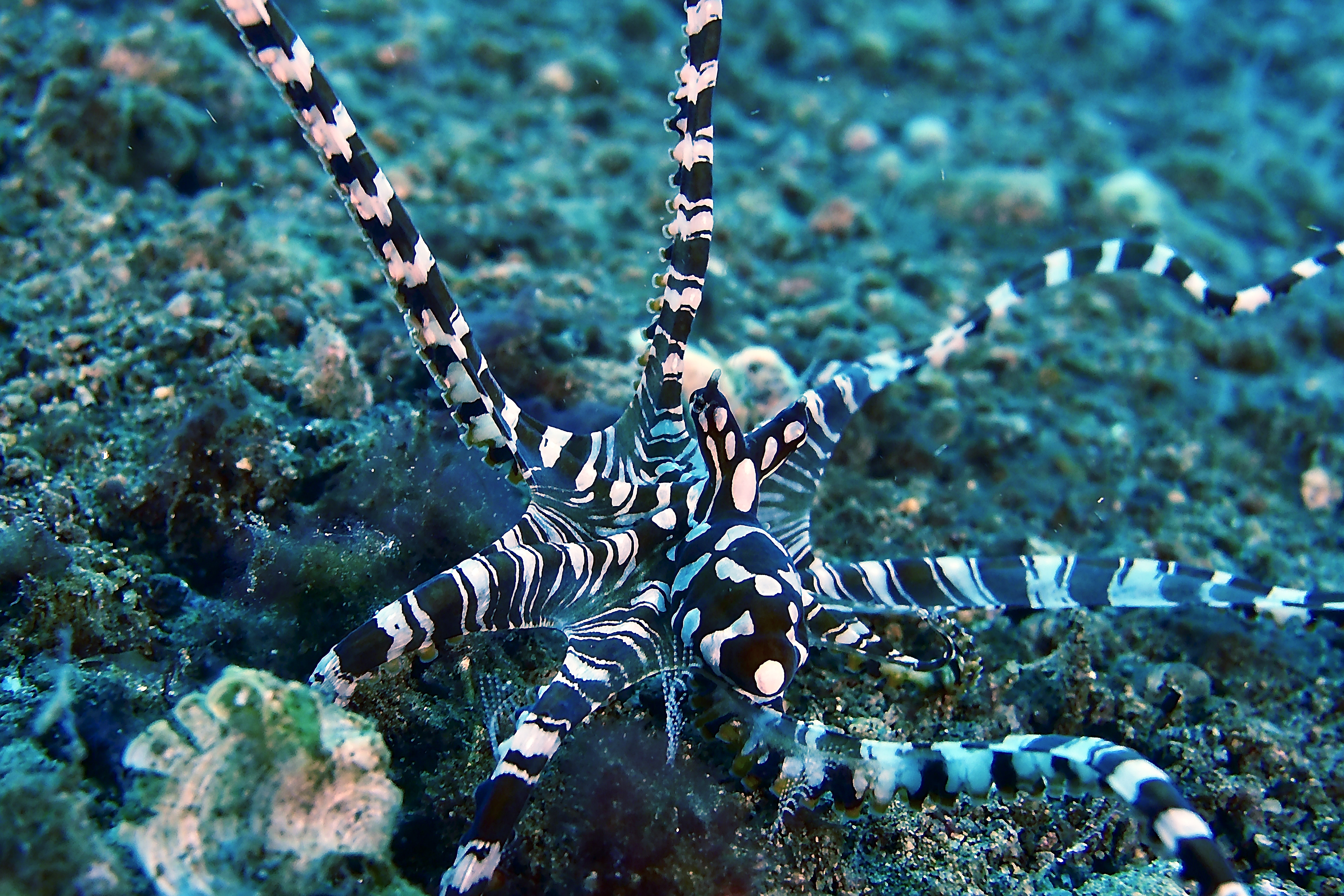
Every year on World Octopus Day (October 8), ocean lovers and scuba divers celebrate one of the ocean’s most intelligent and adaptable creatures. With eight flexible arms, three hearts, and the ability to change color and texture in an instant, octopuses continue to fascinate anyone lucky enough to meet them underwater.
The scientific Latin term octopus was derived from Ancient Greek ὀκτώπους (oktōpous)—a compound of ὀκτώ (oktō, “eight”) and πούς (pous, “foot”)—itself a variant of ὀκτάπους, a word used by the physician Alexander of Tralles (c. 525–c. 605) for the common octopus. The name perfectly captures the defining physical trait of these cephalopods: eight arms capable of remarkable coordination and control.
These three octopus encounters, filmed in St. Vincent, Philippines, and Thailand, offer a glimpse into how these animals thrive across very different marine environments. Beyond any single celebration day, they remind us why patience, awareness, and respect are essential when filming or diving alongside cephalopods.
Off the coast of St. Vincent, an octopus glides quietly across a bed of sea grass, its arms trailing behind in near-perfect balance. The island’s shallow coastal zones are lined with sea grass meadows that shelter juvenile fish, crustaceans, and cephalopods.
Unlike rocky reef settings, sea grass habitats reveal a calmer side of octopus behavior—slow movement, subtle camouflage, and deliberate foraging. These meadows filter light beautifully, creating soft, shifting tones that highlight the octopus’s ability to blend with its surroundings.
Filmed off the coast of Dauin in the central Philippines, this octopus glides over volcanic sand in search of crustaceans hiding beneath the surface. The region’s black-sand slopes and gentle gradients create ideal habitats for species that hunt and burrow.
Local dive sites near Dumaguete are famous for “muck diving”—a slow, detail-oriented style that reveals an astonishing range of camouflaged marine life. Encounters like this one show how patience transforms a seemingly barren seafloor into a living landscape.
Along Thailand’s coral reefs, octopuses use color and texture to blend perfectly with the environment. This individual shifts from mottled browns to coral pinks as it navigates between rock and sponge.
Thailand’s Andaman Sea supports thriving coral systems where macro and mid-sized marine life coexist. For underwater photographers, the combination of good visibility, accessible dive sites, and varied reef structure offers excellent opportunities to document octopus behavior in natural light.
Happy World Octopus Day!


![Theresa [Hey, Traveler] Avatar](https://secure.gravatar.com/avatar/6574ed50b29d3b780d644e1ceab3bed8cd8ac90e2b1ca004646ee8cc232ee86e?s=50&d=monsterid&r=g)


Share Your Thoughts Below