
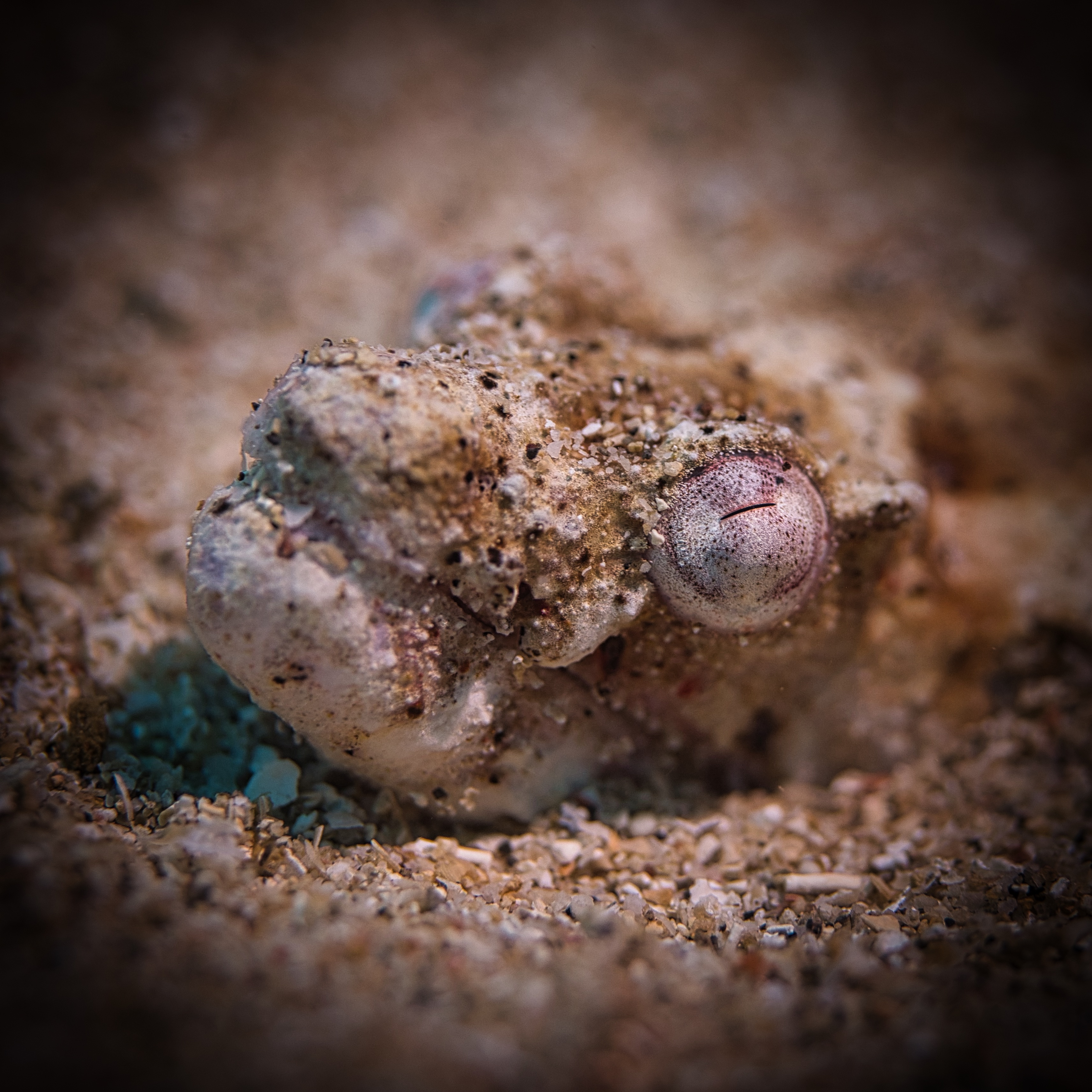
The crocodile snake eel burrows into the sand with only its eyes and snout showing. It looks more like a lurking myth than a real animal. I first met this unusual eel while diving near Siladen Island, Indonesia. It was on a sandy slope where the reef faded into open water. What seemed at first like a random bump in the sand slowly turned into a pair of watchful eyes and a crocodile-like head.
Crocodile snake eels (Brachysomophis crocodilinus) are classic ambush predators. They spend much of their time buried, waiting for fish or cephalopods to wander just a bit too close. For macro-loving divers and underwater photographers, finally spotting one feels like cracking a secret code in the sand.


Click on the photograph to enlarge it.
The crocodile snake eel belongs to the family Ophichthidae. This family includes worm and snake eels known for their elongated bodies. They also exhibit burrowing behaviour. Adults can reach impressive lengths, with males documented up to around 120 centimetres. Their common name comes from the crocodile-like shape of the head. The head has a long snout and strong jaws. Its eyes are positioned high on the head. The body is typically mottled or patterned to blend in with sand, rubble, or coral debris.

Rather than actively chasing prey, the eel waits in place until a small fish or octopus comes within striking distance. Then, with a rapid lunge, it grabs its meal and retreats back into the sand. For divers, the best approach is to move slowly over sandy patches. Divers should scan for eyes or a snout protruding from the seabed rather than looking for a fully swimming eel.
Thanks to the dive guides at Siladen Resort and Spa for pointing out the bright orange eel in the sand.
Are crocodile snake eels dangerous to scuba divers?
Crocodile snake eels are generally considered harmless to humans. They are ambush predators that focus on small fish and cephalopods rather than large animals. Most of the time they remain buried in the sand with only the head showing, and they prefer to stay hidden rather than confront divers. As with any wild animal, giving them space and avoiding physical contact is the best approach.
At what depths do crocodile snake eels usually live?
Scientific references place crocodile snake eels at depths from the intertidal zone down to around 30 metres, with many observations in very shallow water, roughly 0–2 metres. They tend to favour sandy or rubble areas near coral reefs where they can dig burrows and wait for passing prey. For divers, this means they can be encountered on shallow lagoon dives, sand slopes, and reef outskirts rather than only on deep drop-offs.
Where can you see crocodile snake eels in Indonesia?
Crocodile snake eels are part of a wider Indo-Pacific distribution that includes Indonesia, East Africa, the Society Islands, Japan, and Australia. In Indonesia, divers often report them on sandy slopes and lagoon areas near islands such as those around North Sulawesi, where sand and rubble zones sit beside healthy coral reefs. Slow, careful exploration of these habitats gives you the best chance of spotting their distinctive eyes and snout protruding from the sand.


![Theresa [Hey, Traveler] Avatar](https://secure.gravatar.com/avatar/6574ed50b29d3b780d644e1ceab3bed8cd8ac90e2b1ca004646ee8cc232ee86e?s=50&d=monsterid&r=g)


Leave a Reply to FlowerpoetCancel reply