
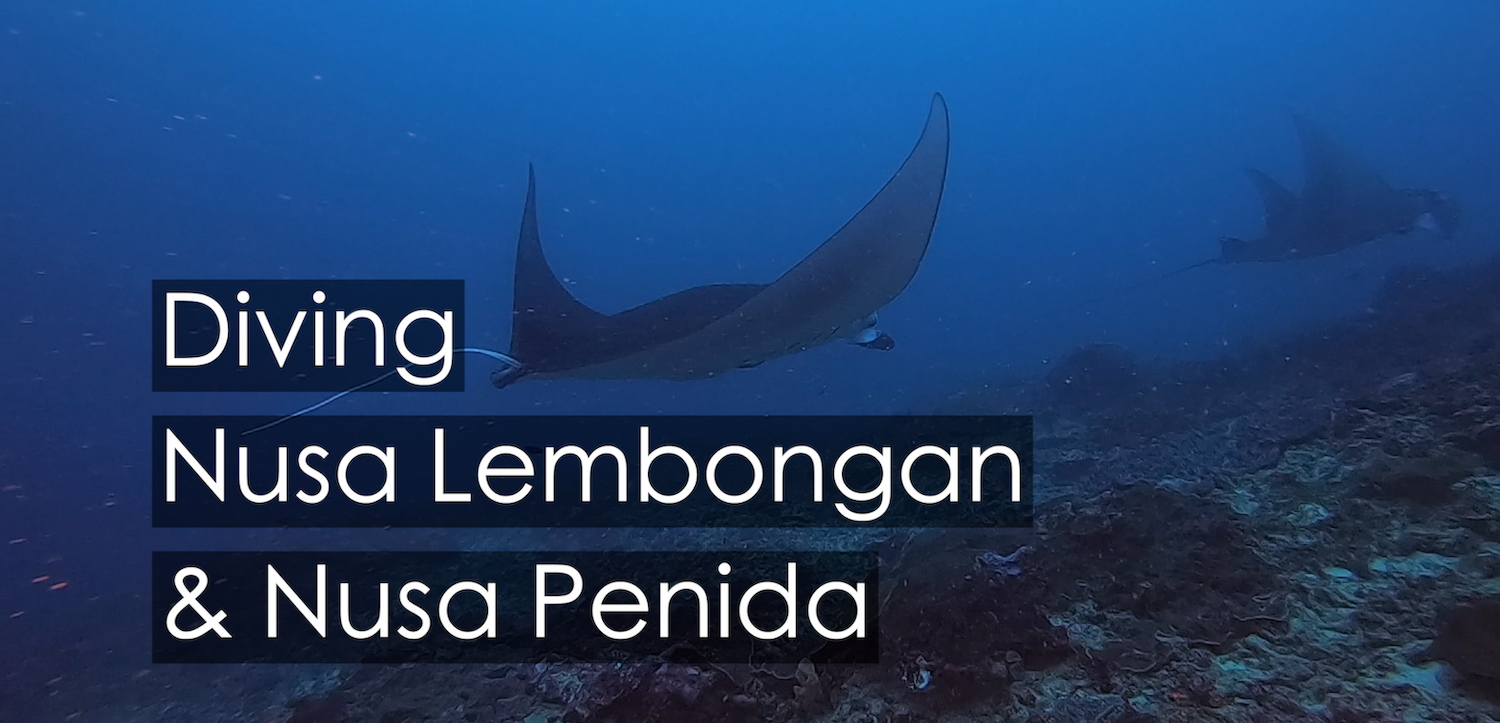
Nusa Lembongan and Nusa Penida are small neighboring islands located off the southeastern coast of Bali, Indonesia. And just off the southern coast of Nusa Penida resides a population of Manta Rays. The Manta Rays can be observed year-round which is fantastic if you have a limited schedule for leisure dive travel. The Manta Rays and the possibility of observing Sunfish (Mola Mola) underwater were my primary reasons for visiting these islands.

Getting to Nusa Lembongan and Nusa Penida is quite easy. There are about 2 or 3 high speed ferry companies that provide access to these islands. It takes about 45 minutes to make the crossing. Most ferry companies will offer to pick you up almost anywhere in Bali’s capital city of Denpasar. The ferry companies make several round trips during daylight hours. I travel with my dive gear (wet suit, BCD, fins, mask, etc.) and there were no additional costs for my baggage. And it didn’t end after the ferry ride, the ferry company delivered me to my hotel on Nusa Lembongan, for a total of about $30 USD round trip. I pre-booked the ferry through my hotel.
I stayed at the Palm Grove Villas, a fantastic hotel with very friendly staff, located in Mushroom Bay on Nusa Lembongan. The pictures on the hotel’s site and Tripadvisor match the actual experience, in my opinion. Overall, the property was well-maintained and in a quiet neighborhood. My villa was about the size of a studio apartment and featured a private terrace, day bed, refrigerator, TV, AC, and decent in-room wifi.

The hotel was recommended by Bas and Kim, the owners of Scuba Center Asia. The dive shop is located next door. So, it made dive logistics quite convenient for me. Mushroom Bay also hosts many other dive operators and hotels, which can accommodate travelers at all budget levels.
Scuba Center Asia is a well-run dive shop with knowledgeable and friendly dive guides. They own and operate several boats, so they can assign them to groups of divers based on skill or training. During the week, I dove with Yayan, Juli B Cool, Dudi, and Alesha – All are fantastic dive guides.
I spent six relaxing days diving with the team. On the first day, we went to look for mantas and found them at Manta Point. There was an abundance of Phytoplankton in the water, which slightly reduced visibility. This was mainly an issue for shooting video. The Mantas in this region are not afraid of divers, so we were able to get pretty close, which was a fine trade-off considering the visibility. Scuba Center Asia takes divers and snorkelers to either Manta Point or Manta Bay several times a week. So, it’s almost guaranteed you’ll be able to dive or snorkel with them several times during your visit, if you desire.
Besides Manta Rays, there is plenty of marine life off the coast of the Nusa Islands. During the week of diving, I observed several species of stingrays, catfish, groupers, anemonefish, triggerfish, angelfish, shrimp, and much more. The coral was quite colorful and thick, a very big difference in comparison to the Caribbean Sea, a region where I learned how to dive and have the most experience diving.
The guides from Scuba Center Asia also took me on a few fun and challenging drift dives. I have a love-hate relationship with very good drift dives. On one hand, you get to see a lot more of a reef, and it’s just fun. We flew over hard and soft coral in many different shapes and sizes. And drifted with a wide variety of fish. On the other hand, it’s hard to stop to take picture or video with a super strong current thrusting you along the reef. The video below (which I originally posted on Instagram) was slowed down by fifty percent.
On the last day of diving, the team took me to a secret location to look for Ocean Sunfish (commonly referred to as Mola Mola). Mola Mola seasonally visits Nusa Penida between July and November. During this period, most divers observe these underwater creatures at a dive site called Crystal Bay. Outside of this time period, sightings of Molas are uncommon. The team took me to an undisclosed area to have a chance of finding them in December.
Mola Molas emerge from the depths to visit cleaning stations. Cleaning stations are locations on the reef where fish and other marine life congregate to be cleaned of parasites, dead skin cells, and bacteria by other underwater animals. In exchange for their services, cleaner fish are generally not eaten and are granted immunity from being consumed by the larger fish they clean.
After six days of fantastic diving, it was time to leave. I would definitely return to dive the reefs of Nusa Lembongan and Nusa Penida again.
I used a Gopro Hero 6 Black to capture the images. My underwater camera set-up can be found here.
My next stop after the Nusa Islands was Tulamben in Bali. You can continue to read about my adventure here.


Share Your Thoughts Below