
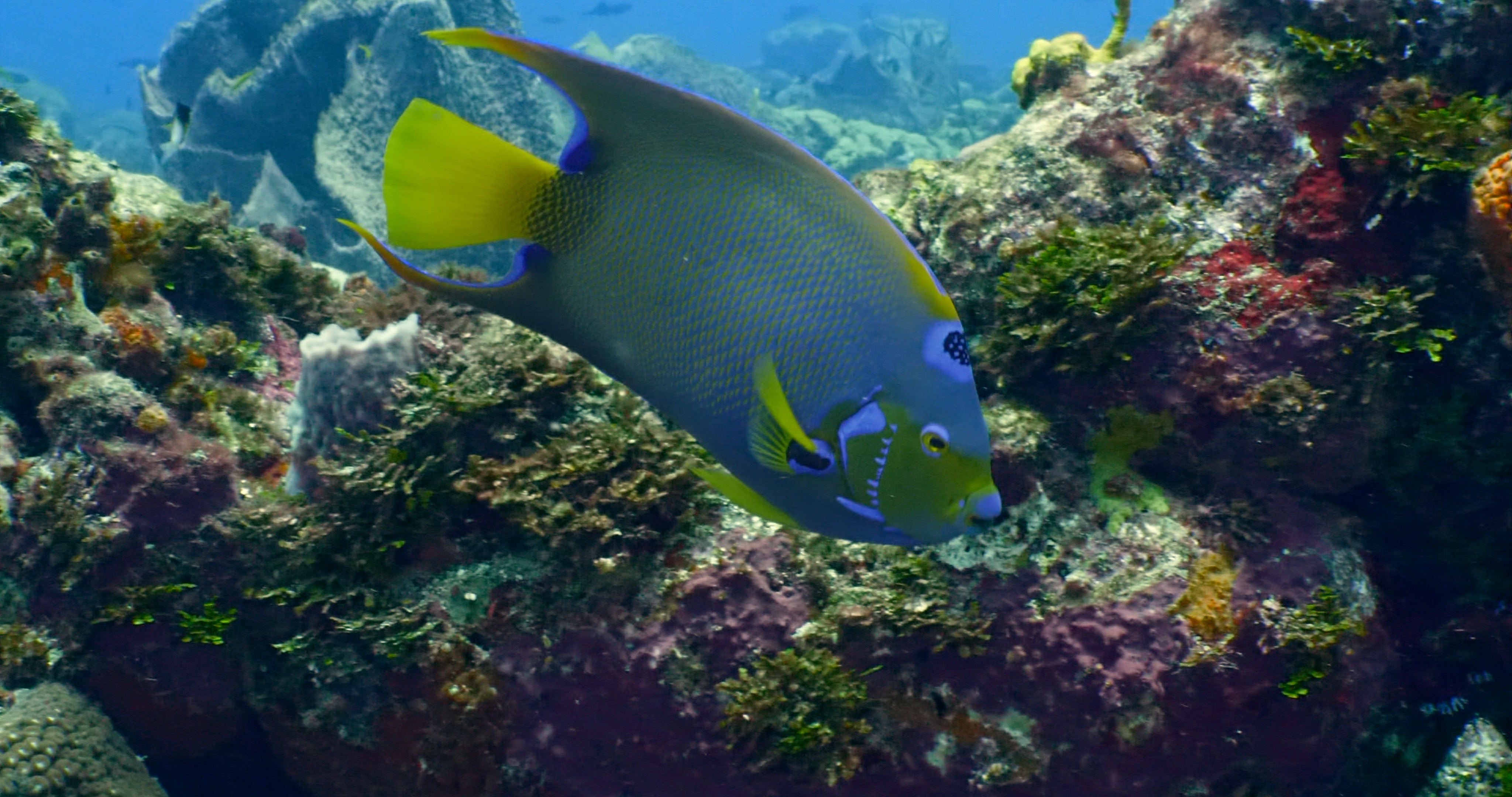
The Queen Angelfish (Holacanthus ciliaris) is widely considered the crown jewel of the Caribbean reef. With its brilliant iridescent colors and majestic movement, spotting an adult on a dive is always a highlight. While they are found throughout the western Atlantic, the nutrient-rich coastal waters of Tobago provide an incredible habitat for observing these magnificent marine animals up close.
Observing how these creatures interact with the local topography reveals a lot about the health of the surrounding reef structure, particularly across the dramatic volcanic drop-offs found around the island.
Queen Angelfish on the Tobago Reef
Behavior and Identification Notes
In this footage, the angelfish navigates the hard and soft coral structures with absolute precision. Pay close attention to its forehead as it turns toward the camera: the electric blue ring encircling a dark spot is fully visible, showing off the iconic “crown” that gives this species its name. Unlike many reef fish that flee immediately when approached, this individual showcases the typical calm, inquisitive behavior that makes underwater cinematography in Tobago so rewarding.
Species Profile & Scientific Data
| Attribute | Field Data |
|---|---|
| Common Name | Queen Angelfish |
| Scientific Name | Holacanthus ciliaris |
| Family | Pomacanthidae (Angelfishes) |
| Max Length | Up to 18 inches (45 cm) |
| Depth Range | 3 to 230 feet (1 to 70 meters) |
| Diet | Primarily marine sponges, tunicates, and algae |
Key Identification Markings
Identifying them accurately requires looking for a few specific physical traits. It is also important not to mistake them for the closely related Blue Angelfish (Holacanthus bermudensis), with which they occasionally hybridize.
The Crown
The absolute definitive feature of Holacanthus ciliaris is the distinct black or dark blue spot on the forehead, entirely ringed by a brilliant, electric neon-blue edge. This marking resembles a crown and is present on all adults.
Body Coloration & Fins
- Vibrant Contrast: The body transitions from a deep teal-blue to a vibrant yellow-gold along the scales, catching the light dramatically as they turn.
- Solid Yellow Tail: The caudal fin (tail fin) is entirely solid yellow, which is a major differentiator from hybrid species.
- Streaming Filaments: The dorsal and anal fins terminate in long, elegant trailing filaments that extend well past the tail.
- Bright Accents: The pectoral and ventral fins are bright orange-yellow, while the edges of the gills feature sharp electric-blue highlights.
The Juvenile Transformation
Shallow reef structures or finger corals often reveal juvenile Queen Angelfish. They look entirely different from adults, featuring a dark blue body covered in vertical, curved, light-blue bars. As they mature, these bars fade, the body lightens into teal and gold, and the signature forehead crown develops.
Habitat and Behavior on Caribbean Reefs
Queen Angelfish are highly dynamic reef residents, typically observed swimming solo or in bonded pairs moving methodically along coral walls and sloping drop-offs.
Dietary Ecology
Their diet is highly specialized, consisting almost entirely of marine sponges. Because sponges can be tough and toxic, the Queen Angelfish uses its specialized jaws to shear off pieces, playing a critical role in reef ecology by keeping aggressive sponge growth from overwhelming slow-growing hard corals.
They are territorial but curious. When a diver or cinematographer approaches slowly without sudden movements, a Queen Angelfish will often turn sideways to inspect its visitor, providing an exceptional window for clean tracking shots.
Diving the Tobago Systems
Tobago offers a distinct advantage for marine life viewing due to its unique oceanographic position. Fed by the nutrient-dense currents flowing up from South America, the waters surrounding the island support a massive biomass of sponge and soft coral growth. This richness creates an exceptionally healthy, mature reef profile across major sites.





Share Your Thoughts Below