
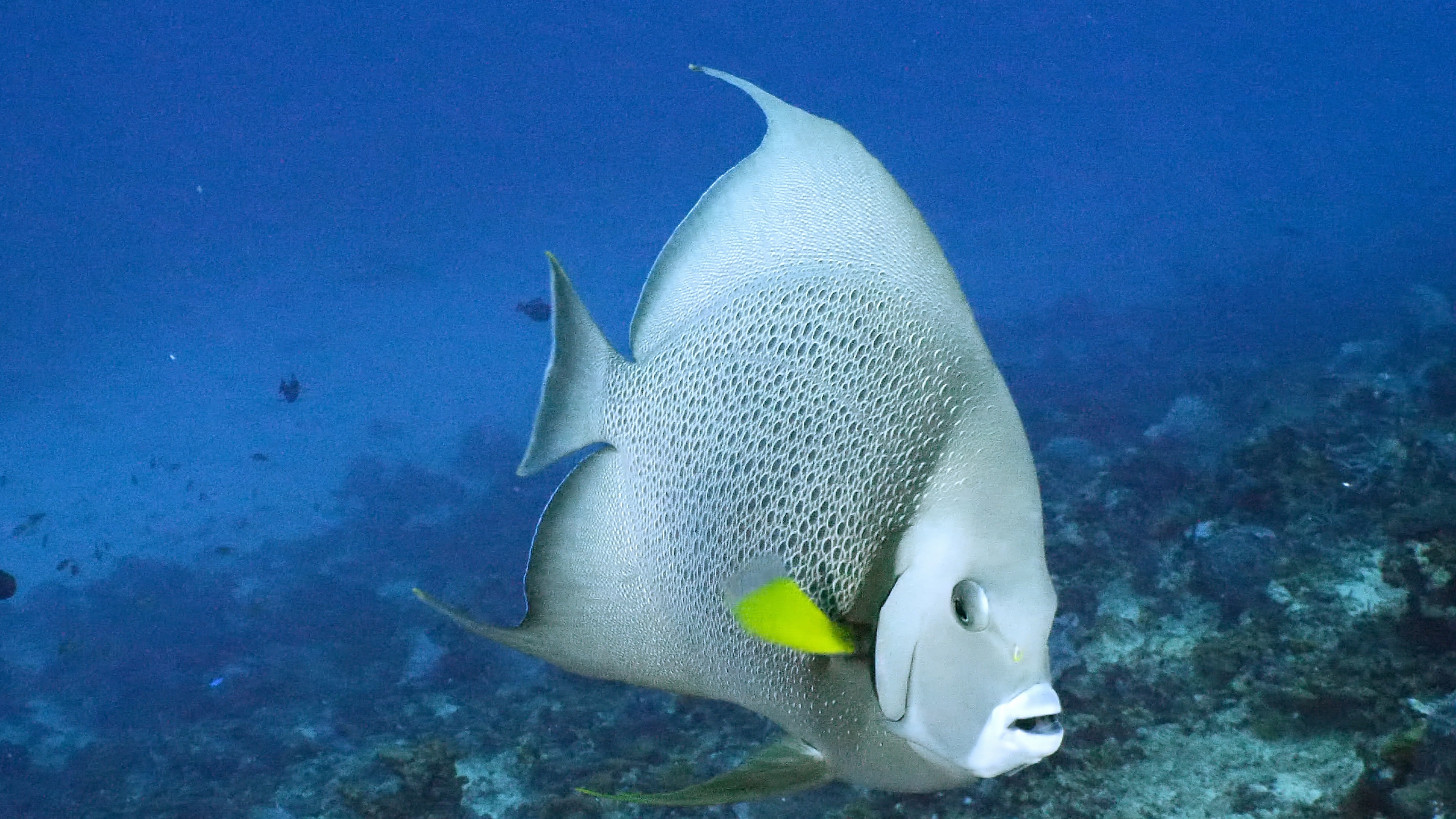
The Grey Angelfish (Pomacanthus arcuatus) brings an understated elegance to the reefs of the Caribbean. While it lacks the loud, neon color palette of its relative, the Queen Angelfish, its intricate scale patterns, grand profile, and calm demeanor make it a phenomenal subject for underwater cinematography and marine life observation.
Tracking these fish as they navigate deep coral systems reveals a highly social, territorial nature that stands out against the fast-paced activity of smaller reef residents.
Grey Angelfish on the Tobago Reef
Behavior and Identification Notes
Filmed off Tobago’s northeast coast—an area renowned for nutrient-dense water clarity—this mature individual showcases classic adult behavior. It cruises through its domain with an air of calm curiosity. Rather than darting away, it approaches the lens directly, investigating the housing and pausing to give a clear view of its square body profile, before gracefully drifting backward into the deep blue.
Species Profile & Scientific Data
| Attribute | Field Data |
|---|---|
| Common Name | Grey Angelfish (Gray Angelfish) |
| Scientific Name | Pomacanthus arcuatus |
| Family | Pomacanthidae (Angelfishes) |
| Max Length | Up to 24 inches (60 cm) |
| Depth Range | 6 to 100 feet (2 to 30 meters) |
| Diet | Sponges, tunicates, zoanthids, and macroalgae |
Key Identification Markings
While sometimes confused at a distance with the French Angelfish (Pomacanthus paru), the Grey Angelfish has several distinct diagnostic characteristics that become very apparent under close visual tracking.
Body and Patterning
- Monochromatic Mesh: The primary body color is a uniform light-to-mid grey or grey-brown. Each scale features a dark center and a pale edge, giving the fish a beautifully textured, cross-hatched appearance.
- Pale Mouth: The mouth and the immediate surrounding area are distinctly pale white or light grey, presenting a sharp contrast to the darker face.
- Yellow Fin Details: The inner surface of the pectoral fins features a bright yellow coloration, which serves as an excellent visual marker when the fish is banking or turning.
- Fin Geometry: The dorsal and anal fins are large, sweeping backward significantly, giving the fish a pronounced square silhouette.
The Juvenile Phase
Just like the Queen Angelfish, juveniles look vastly different from adults. A young Grey Angelfish has a dark brown or jet-black body covered in vertical, yellow bars crossing its body. The key tell to separate a juvenile Grey from a juvenile French is the tail fin: the yellow bars on a juvenile Grey extend cleanly across the tail, whereas a juvenile French features a rounded tail ringed completely in yellow.
Ecology and Behavior
Grey Angelfish are highly social within their species, frequently seen traveling in lifelong, monogamous pairs. They are diurnal, actively foraging along the reef during daylight hours and seeking shelter inside deep ledge underhangs at night.
Reef Utility
As massive sponge-eaters, they clean large swaths of substrate. This foraging strategy is highly beneficial to the reef, exposing new rock faces where larval corals can naturally settle and attach without being choked out by aggressive sponge growth.
Because they are comfortable around divers, they do not exhibit erratic flight patterns. Approaching with slow, rhythmic breathing usually lets you maintain a steady frame for close macro or tracking sequences.
Diving the Tobago Systems
Tobago offers a distinct advantage for marine life viewing due to its unique oceanographic position. Fed by the nutrient-dense currents flowing up from South America, the waters surrounding the island support a massive biomass of sponge and soft coral growth. This richness creates an exceptionally healthy, mature reef profile across major sites.





Share Your Thoughts Below