
Logistics & Nearby Stay
Fuvahmulah Dive is one of the standout dive operations on Fuvahmulah, a single-island atoll in the southern Maldives surrounded by open Indian Ocean. That setting helps explain why the island has become one of the world’s most talked-about pelagic diving destinations. Tiger sharks are a year-round draw, while other headline species — including threshers, oceanic mantas, hammerheads, and whale sharks — add to the destination’s appeal across different seasons.
From the start, the team was super responsive throughout the booking process and presented several dive-and-stay package options. I booked a 9-night package that included 7 dive days, 21 dives, full-board meals, and all transfers. I stayed at Zero Degree Residence, a clean and comfortable guesthouse about 15 minutes from the dive shop, with solid air conditioning, reliable Wi-Fi, and everything I needed between dive days. One thing worth knowing before you book: Fuvahmulah is an alcohol-free island. There are no bars or alcohol available at guesthouses or restaurants. If that’s a priority for your surface intervals, plan accordingly.
Getting to Fuvahmulah requires a domestic connection through Malé. After arriving at Velana International Airport, I walked to the domestic terminal and boarded a Maldivian Airlines flight to Fuvahmulah. The flight is typically around an hour and a half, and in my case the outbound was nonstop while the return included a stop. I had a layover of roughly three to four hours in Malé, which I spent in the outdoor lounge by the water. From Malé onward, Fuvahmulah Dive handled the logistics smoothly, arranging the domestic flights as part of the package.
On dive days, the routine was simple and well organized: pickup each morning for two dives, return to the hotel for lunch, and then another pickup for the afternoon dive. The transitions were seamless and the pace never felt rushed.
How I Got Here
✈️ DOH → MLE
✈️ MLE → FVM
Share This Review
Dive Operation & Boat Setup
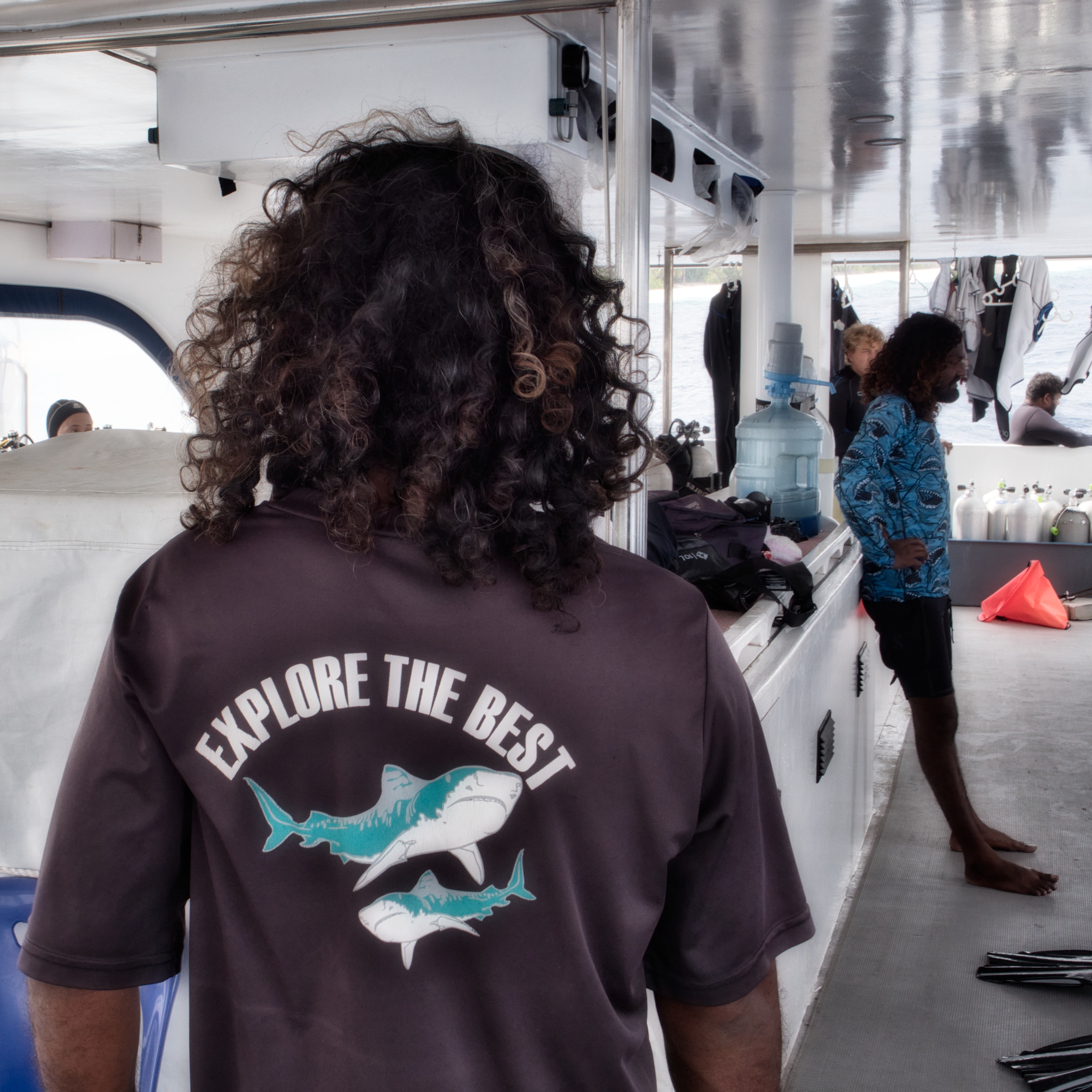
Fuvahmulah Dive operates out of the island’s fishing port. The dive shop sits dockside in the harbor area, and the boats are less than a minute’s walk from the facility. Each morning, the team picked me up from the hotel and brought me to the shop, where gear was transferred to the boat before departure.
The operation runs two dive boats — traditional Maldivian dhoanis — with capacities of 15 and 20 divers. Both are equipped with toilets, freshwater showers on deck, and onboard compressor systems. The boats were typically full on shark-specific dives, but the operation segments divers into smaller groups with dedicated divemasters, so it never felt crowded in the water.
Dives fall into three general categories depending on the day’s plan and conditions: deep open ocean dives targeting thresher sharks, whales, and mantas; reef dives along the island’s perimeter; and the Tiger Shark Zoo dives, which take place directly in front of the fishing port.
The Tiger Zoo dives were the centerpiece of the week. We did at least one per day, rotating between morning, mid-morning, and afternoon slots. The dives are relatively stationary — divers position themselves in designated areas along the bottom to observe the sharks as they move through. Different tiger sharks showed up at different times, so no two sessions felt the same. The operation takes safety seriously here. Multiple safety divers are positioned around the group, watching and protecting from all angles. Each diver is given a metal pole for protection. That said, if you’re carrying a large camera rig, the pole is not recommended — it gets in the way more than it helps.
Fuvahmulah Dive also offers specialty courses. During this trip, I completed my PADI DPV (Diver Propulsion Vehicle) certification. The DPV proved useful beyond the course — currents here can be strong, and operating a scooter made it significantly easier to keep pace with large animals moving through open water.
The remaining dives — open ocean and reef — added variety across the week and kept 21 dives from feeling repetitive. Safety and shark briefings were conducted at the dive shop before heading to the boat. Site-specific briefings were given on board before each dive. Given the nature of the diving here — open ocean, large sharks, and variable currents — the structured briefing process felt appropriate and well practiced.
Would I visit again
Yes
Diving & Marine Life
During the week, we encountered male and female tiger sharks, manta rays, sailfish, sand tiger sharks, and silvertip sharks. Water temperatures held steady between 28–30°C (82–86°F), and visibility usually ranged from 20 to 30 meters depending on the dive site and prevailing conditions.
Tiger sharks were the defining presence of the trip, with dependable daily encounters at Tiger Zoo, though the behavior and mood of each dive varied noticeably. On one dive, a female with a visibly broken jaw passed through the group — a powerful reminder that these are not staged encounters, but interactions with wild animals marked by experience and survival. On several blue-water dives, male tiger sharks moved through the open ocean with a sharper, more predatory energy, creating a very different atmosphere from the more measured dynamic at Tiger Zoo. One of the week’s more surprising moments was seeing a sand tiger shark along the reef, a species not commonly associated with the Maldives.
The open-ocean diving here stands apart from typical reef diving. Many of these dives are deep — that’s where the big animals spend their time. Sharks, whales, and mantas move through deeper water columns, so reaching them means committing to depth. There is no wall, pinnacle, or coral slope to frame the experience — only deep blue water and the expectation that something large may appear out of it. Currents can be strong on both the offshore and certain reef dives, increasing the physical demands of the diving while also helping explain why pelagic encounters here are so consistent. Fuvahmulah’s isolated position in deep Indian Ocean water gives the island a uniquely oceanic character, and that setting is central to its reputation.
The reef dives offered a useful counterbalance. Along the reef, there was healthy coral structure and a fish community characteristic of the Indian Ocean, along with solid opportunities for wide-angle and macro compositions. While the pelagic action defines Fuvahmulah, the reef diving added variety and gave the week a more complete rhythm.
MONTH VISITED
Quick Facts
- Diving: Boat
- House Reef: No
- Multiple Boats: Yes
- PADI: 5 Star Dive Center
- Lodging: Dive & Stay Options
Featured Images


