
Most of these encounters were captured from a liveaboard exploring the inner islands. The rest come from day-boat dives operating out of a resort on Mahé.
The inner Seychelles sit on granite. They are continental fragments left behind when India pulled away from Madagascar, and they are the only granitic islands in the middle of an ocean anywhere on Earth. Underwater, granite breaks into boulder fields, stacked slabs and deep fissures. Hard coral grows over and between the rock instead of forming the structure itself. It creates a different kind of dive than an atoll — fewer sheer walls, more fractured terrain and natural swim-throughs.
Gallery One
On the Reef
Granite and coral in roughly equal measure. Bigeye soldierfish feed at night and spend most of the day back in caves and under ledges, so a school holding in open water above the reef is worth stopping for. The sergeant majors were in the shade beneath the hull of the boat. The shadow line attracts fish all day long.


Gallery Two
Batfish
Batfish are among the few reef fish that will come to you rather than away. These are orbicular batfish, Platax orbicularis — adults reach about 50 cm and go almost perfectly circular in profile, and the species has the widest range in the genus, from the Red Sea and East Africa across the Indian Ocean to the Tuamotus.[1] They shift tone while you watch, silver through to brown, the dark bars deepening and fading again, which makes exposure a moving target.


Gallery Three
Nudibranchs
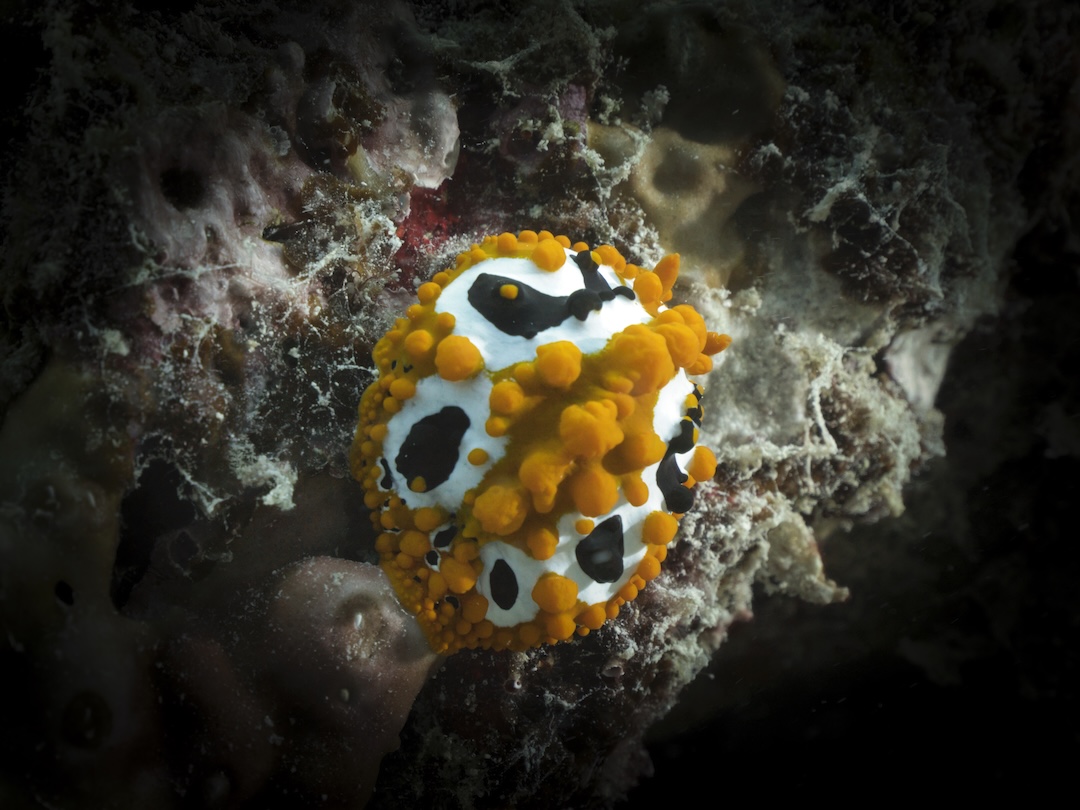
Two species here, both in the family Phyllidiidae: Phyllidia varicosa, black with yellow-capped tubercles, and Phyllidia ocellata, orange with black and white rings.
Phyllidiids are built differently from most nudibranchs. There is no gill plume on the back; the gills are tucked out of sight in the groove between the mantle and the foot.[2] There is no radula either — they have no jaws or rasping teeth and feed by suction on sponges, and they carry the sponge chemistry with them. The defensive compound first isolated from Phyllidia varicosa in 1975 came out of the sponge it eats.[3]
The colour is a warning rather than camouflage, which is also why they are easy to shoot. They sit out in the open in daylight and they do not hurry.


Gallery Four
Octopus
Two animals across three frames. The pale one had backed into a crevice beside an orange coral head, skin gone smooth and almost white. The other turns up twice on the same dive — once dark and high-contrast over the reef, once mottled brown and green with an arm stretched out across the rock. Same octopus, two different skins.
Octopus change colour and texture at once and by separate mechanisms: pigment cells for the colour, muscular papillae for the raised, lumpy surface that matches rock and coral. Neither animal moved much. The reaching arm was about as far as any of it went.


Gallery Five
Navigating the Reef
While the scorpionfish relies entirely on holding perfectly still to ambush prey, the rest of this gallery captures subjects on the move. Moray eels are usually spotted with just a head poking out of a hole—holding their jaws wide to pump water over their restricted gills—but it is much more compelling to catch them out in the open. The large grey moray here is fully extended, actively winding its length across the sand and coral base to relocate.
Above the substrate, the cowfish maneuvers differently. Encased in a rigid, box-like carapace, it cannot undulate its body to swim. Instead, it hovers over the reef structure, relying entirely on rapid, precise fin movements to propel itself through the water column.


Gallery Six
Echinoderms
The big reddish animal with the pointed teats is a prickly redfish, Thelenota ananas. The IUCN Red List assesses it as Endangered, with populations estimated to have fallen 80 to 90 percent across at least half its range, driven almost entirely by the bêche-de-mer trade.[4]
Seychelles runs one of the larger sea cucumber fisheries in the western Indian Ocean, and it is a managed one. The Seychelles Fishing Authority caps the number of fishing licences, limits each licence to four divers, and sets species-by-species catch quotas.[5] Prickly redfish is one of the quota species. Finding a large one sitting out on the reef is worth a frame.
The rest of the gallery is sand-work and stars: a blackspotted sea cucumber with its paddle-shaped feeding tentacles out, running sediment through its gut and stripping the organic material off it, and two sea stars — a cushion star inflated into a pentagon, and a pale granulated sea star with the short, thick arms that give the species its shape.


Gallery Seven
Coral Restoration
Nursery frames on a reef in the inner islands, with coral fragments growing along the bars. I didn’t note which programme runs this particular site, but the method is the same one used across the archipelago: grow fragments on a structure until they are large enough to hold, then transplant them onto degraded reef.
Seychelles has a long history with this work, largely because it had no choice. The 1998 bleaching event cut coral cover in the inner granitic islands to under three percent at some sites, with no depth refuge, and what followed was rubble and algae.[6] Recovery ran for the better part of two decades and was interrupted in 2016 by a second mass bleaching, in which Seychelles was the worst-affected country in the western Indian Ocean — more than half of monitored sites showed high bleaching, and at some sites mortality passed 90 percent.[7]
The best-known effort here is Nature Seychelles’ Reef Rescuers, launched on Praslin in 2010 — the first attempt anywhere to trial coral gardening at large scale.[8] Nursery-and-transplant work now runs at sites across the inner islands, which is why frames like these turn up on ordinary dives.


Above the surface the Seychelles was doing its own thing, which is covered separately in Chasing Clouds Seychelles and Shooting the Moon.
Reviews
Where I Dived
Write-ups of the boats, dive shops and resorts behind these photographs — in the Indian Ocean and everywhere else I’ve put a camera in the water.
More From the Seychelles
Sources
- Reef Life Survey. Platax orbicularis — round batfish.
- Brunckhorst, D.J. 1993. The systematics and phylogeny of phyllidiid nudibranchs (Doridoidea). Records of the Australian Museum, Supplement 16.
- Burreson, B.J., Scheuer, P.J., Finer, J. and Clardy, J. 1975. 9-Isocyanopupukeanane, a marine invertebrate allelochemic with a new sesquiterpene skeleton. Journal of the American Chemical Society 97(1).
- Conand, C., Gamboa, R. and Purcell, S. 2013. Thelenota ananas. The IUCN Red List of Threatened Species.
- Seychelles Fishing Authority. Sea Cucumber Fishery — management measures and quotas.
- Graham, N.A.J. et al. 2006. Dynamic fragility of oceanic coral reef ecosystems. PNAS 103(22).
- Reef Resilience Network. Seychelles — Coral Restoration (case study).
- Nature Seychelles. Coral Reef Restoration — Reef Rescuers.



Share Your Thoughts Below