
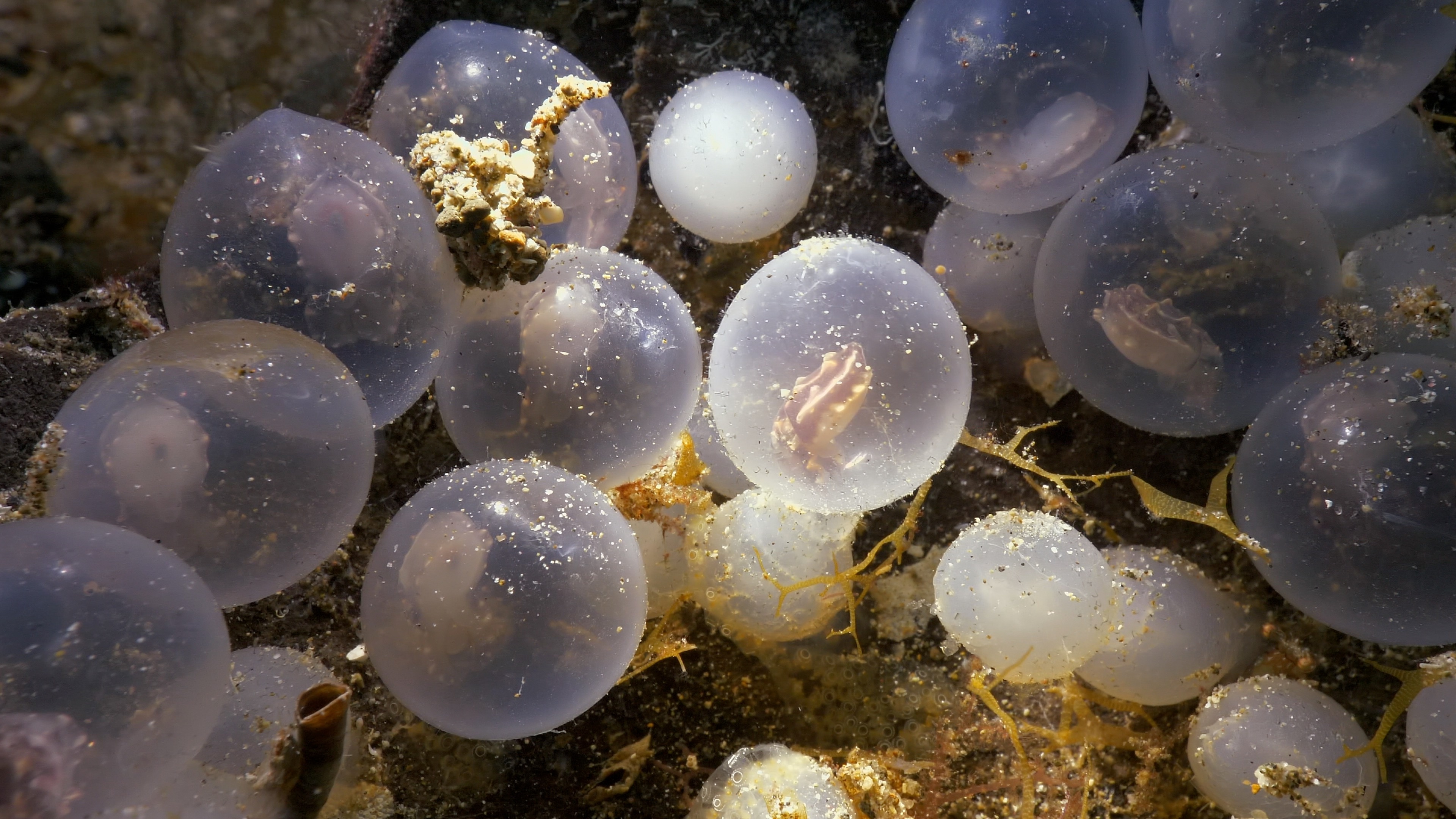
The flamboyant cuttlefish — Metasepia pfefferi — is one of the most sought-after macro subjects in the Indo-Pacific. These embryos, filmed developing inside their translucent egg casings in Anilao, Philippines, offer a rare window into cephalopod life before hatching.
Metasepia pfefferi — Species Identification
- Scientific Name Metasepia pfefferi (Hoyle, 1885)
- Common Name Flamboyant Cuttlefish
- Classification Family Sepiidae — Cuttlefishes (Order Sepiida, Class Cephalopoda)
- Appearance Eggs are translucent-white spheres; embryos visible inside, showing miniature adult characteristics. Adults feature a dark brown base with shifting, vibrant waves of yellow, pink, and purple, along with distinct flap-like papillae along the mantle.
- Size Up to 8cm (3.1″) mantle length
- Diet Carnivore — small fish and crustaceans, captured with two long feeding tentacles
- Range Tropical Indo-Pacific; northern Australia, southern New Guinea, Philippines, Indonesia, and Malaysia. Sand and mud substrates, typically 3–86m depth.
- Taxonomy Note WoRMS now lists the accepted name as Ascarosepion pfefferi. Metasepia pfefferi remains the widely used name in field guides and dive communities.
Anilao, in the province of Batangas, is one of the Philippines’ premier macro diving destinations — and one of the more reliable places to encounter flamboyant cuttlefish in the wild. The muck sites here are characterized by dark volcanic sand and rubble slopes where M. pfefferi hunts, mates, and deposits eggs in the crevices beneath rocks and discarded shells.
What makes encountering a cluster of flamboyant cuttlefish eggs so compelling is the sheer level of detail visible through the egg wall. They do not develop passively; the embryos constantly move, reorienting themselves inside the fluid-filled spheres. The rapid firing of their color-changing cells occurs in response to light, movement, and structural changes as they approach maturity. Within days of reaching this highly active phase, they emerge completely independent — small, fierce, radiant, and fully equipped to hunt.
Prenatal Color Change: One of the more remarkable aspects of flamboyant cuttlefish development is that the chromatophore system becomes functional before hatching. Late-stage embryos can be observed pulsing with color inside the egg — the same chromatic signaling that defines the adult animal, visible through the transparent egg wall before the animal has taken its first breath of open water.
Walking, Not Swimming: The flamboyant cuttlefish is one of only two cuttlefish species known to habitually “walk” across the seafloor, using modified ventral arms and flap-like fins in a rhythmic gait. The cuttlebone in M. pfefferi is unusually small relative to its body — too small to provide the buoyancy most cuttlefish rely on for sustained swimming. The result is an animal that spends most of its time on the substrate, and the walking behavior is visible almost immediately after hatching. This Lembeh Strait encounter shows adult walking and chromatic display behavior in the wild.
Lifespan and Reproduction: Flamboyant cuttlefish live an estimated 18–24 months. Both sexes die shortly after mating and egg-laying — the female deposits her clutch of 5–25 eggs and provides no parental care. The eggs are left to develop on their own, typically hatching after 35–40 days depending on water temperature. Hatchlings emerge as fully independent miniatures of the adult, immediately capable of hunting, walking, and producing chromatic displays.
Filming Embryos in the Field: Shot on the Panasonic GH5 with an Olympus 60mm macro lens in a Nauticam housing. Embryo footage demands a different approach than filming adults — the subject doesn’t move away, but the working distance is tight, the depth of field at this magnification is razor-thin, and any disturbance to the surrounding substrate can obscure the egg in a cloud of silt. Patience and stable buoyancy are the entire technique.





Share Your Thoughts Below