
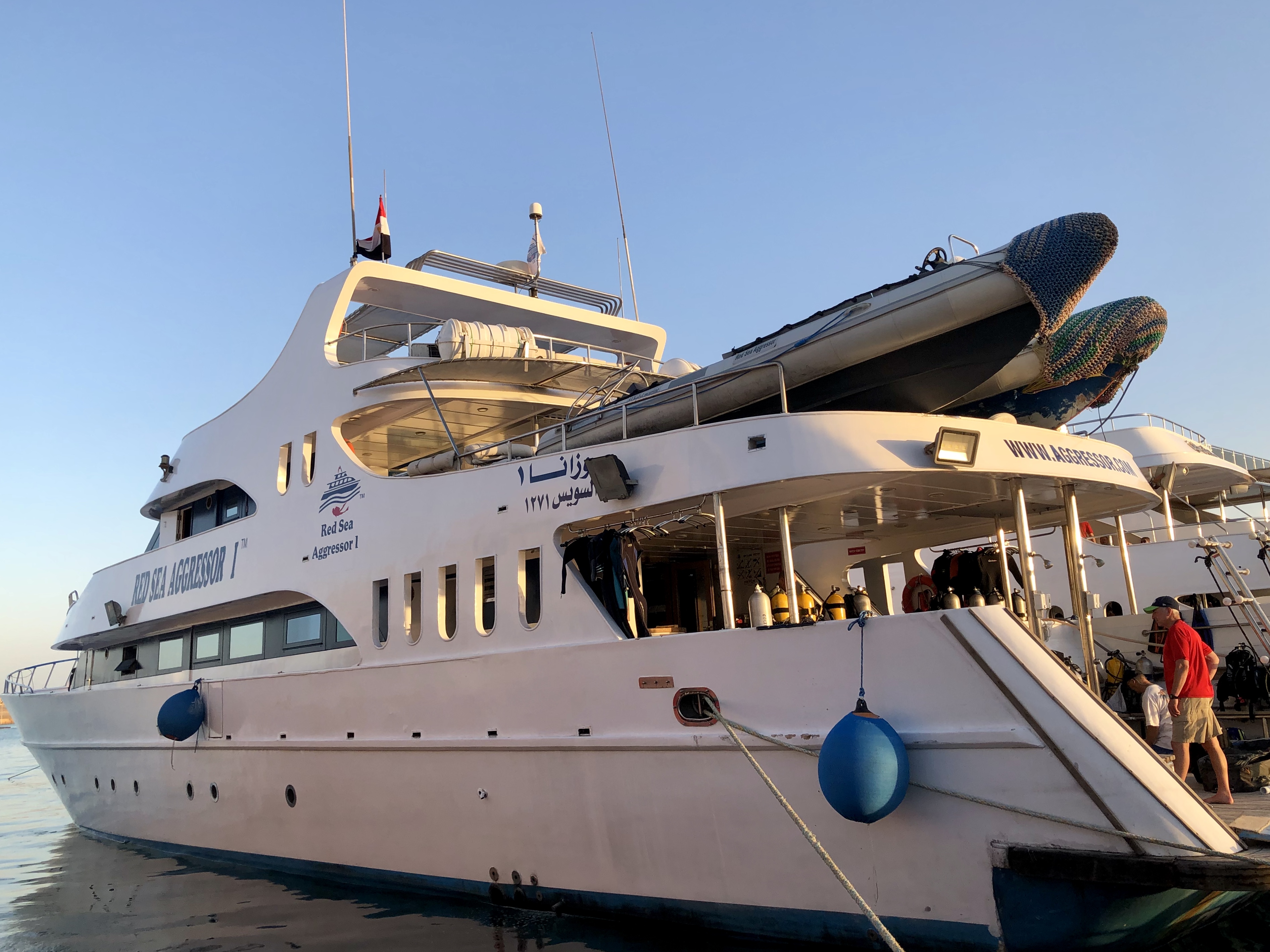
Liveaboard & Accommodation
Editor’s Note: As of February 2026, the Red Sea Aggressor IV operates under a new vessel — the M/Y Turquoise — a five-deck, 138 ft liveaboard. This review reflects the original vessel and the St. John’s & Daedalus itinerary.
I flew Royal Jordanian out of JFK with a connection through Amman to Cairo. From there, I spent a few days in Giza to see the pyramids and the Sphinx before heading south — a worthwhile detour if you’re making the long haul to Egypt. Uber works reliably in Cairo and is the easiest way to get around. My base in Giza was the Le Méridien Pyramids, a comfortable hotel with direct sightlines to the pyramids. After a few days, I caught a domestic EgyptAir flight south to Marsa Alam International Airport (RMF).
The most convenient route to the Red Sea Aggressor IV is to fly into Marsa Alam — the airport is less than 15 minutes from Port Ghalib Marina, and Aggressor provides a complimentary shuttle for guests arriving on embarkation day. Divers do have the option to fly into Hurghada (HRG), but that requires an additional 3.5-hour drive south to Port Ghalib. Unless you have a specific reason to route through Hurghada, Marsa Alam is the right call.
The standard embarkation window is Saturday between 3:00 PM and 6:00 PM. I arrived two days early and stayed at the Marina Lodge at Port Ghalib, which sits directly within the marina complex and is the most practical pre-trip hotel for liveaboard guests. The hotel offers a breakfast package, and the rooms are clean, comfortable, and quiet. One thing worth knowing: the marina is split into two sections. The hotel and boat berths are on one side; restaurants, cafes, and shops are on the other. A short water taxi connects them for a few dollars each way — US dollars are accepted. There are nicer hotels in the marina if budget allows, but the Lodge’s proximity to the dock is hard to beat. At the end of the trip, I purchased a day room pass before my late-evening flight out of Marsa Alam — a small convenience that made the last day significantly more comfortable and worth asking about when you book.
Before boarding, I used my two days in Marsa Alam to get in the water with a local independent dive guide named Amr Mohamed, who arranged a private two-dive session at a site known for resident dugongs. The Red Sea Aggressor does not hold a permit for this site, so it has to be arranged independently before or after the charter. I’ve written about that experience in full here.
The Red Sea Aggressor IV is a purpose-built liveaboard designed to access the remote reefs of Egypt’s southern Red Sea. Operating out of Port Ghalib Marina, the boat accommodates up to 26 guests across 13 staterooms, each with its own climate control, private head and shower, hairdryer, and mirrored cabinets. I stayed in a deluxe stateroom — two single beds side by side, comfortable for the week, with one practical detail that matters on a liveaboard: storage underneath the beds is sized to fit large gear bags and luggage, keeping the cabin floor clear for the duration of the trip.
The main salon is a spacious, air-conditioned space used for dive briefings, fish identification presentations, and media review sessions between dives. For outdoor relaxation, the sun deck offers chaise lounges, deck chairs, and a bar. Meals are served family-style or buffet, featuring a blend of Egyptian and Western cuisine. Complimentary beverages include fruit juices, soft drinks, tea, and coffee. Beer and wine are available but served only after the final dive of the day — standard practice across the Aggressor fleet.
Location
Red Sea Aggressor
Southern Itinerary (St. Johns & Daedalus)
Marsa Alam (Port Ghalib)
Liveaboard
EgyptHow I Got Here
✈️ AMM → CAI
🏨 Layover in Giza
✈️ CAI → RMF
Share This Review
Dive Operation & Facilities
The Red Sea Aggressor IV is built for high-frequency, remote-access diving. The standard seven-night charter averages 20 to 23 dives, including several night dives when conditions permit. On the St. John’s and Daedalus itinerary, nearly all diving is conducted from the vessel’s three tenders rather than from the mothership’s back deck — a format well-suited to the exposed seamounts and protected reef systems that define this route.
Embarkation day is Saturday, dedicated entirely to boarding, equipment setup, and a detailed boat briefing followed by dinner. Diving officially begins Sunday morning after obtaining port clearance from Egyptian authorities. Before departing for the first site, the crew conducts a mandatory safety briefing and drill, followed by a checkout dive on a sheltered reef to verify weighting and equipment functionality — standard Aggressor procedure and a sensible way to start a week of remote diving.
Each diver is assigned a fixed gear station on the dive deck with an integrated storage box for masks, fins, and small accessories. The deck layout features dual staircases leading to the swim platform. For photographers and videographers, the deck includes a dedicated camera station with low-pressure air hoses for drying housings and separate rinse tanks designated specifically for optical equipment — a detail that matters when you’re running multiple dives a day in saltwater. Nitrox is available at a weekly rate for certified divers.
The operation runs smoothly in the water. Tender-based diving keeps groups manageable at each site, and the crew handles the logistics of positioning and pickup efficiently — particularly important at a site like Daedalus, where current direction and drift distance require precise timing on the surface. Briefings are thorough and site-specific, covering entry method, current conditions, depth profiles, and notable marine life. On the last day of diving, two dives are offered before returning to Port Ghalib.
Would I visit again
Yes
Diving & Marine Life
The St. John’s and Daedalus itinerary targets the deep south of the Egyptian Red Sea — an area characterized by healthier coral systems and more consistent pelagic activity than the heavily dived northern reefs. The route offers a technical contrast between two very different underwater environments: the topographical labyrinths of St. John’s and the exposed, current-swept seamount of Daedalus Reef.
St. John’s sits on the Tropic of Cancer, a collection of remote reefs offering exceptional biodiversity and unique underwater architecture. The area is best known for its caves, tunnels, and swim-throughs — a different experience from the wall diving found elsewhere in the Red Sea. The standout site is St. John’s Caves, locally known as Umm Kharalim, a shallow reef system characterized by an expansive network of tunnels and sun-filled chambers. Depths average around 36 feet, which allows for extended bottom times and optimal use of natural light. For underwater cinematographers, this site is exceptional — sunbeams filter through cracks in the reef ceiling, creating illuminated passageways that reward wide-angle shooting. It is one of the more visually distinctive dive sites in the Red Sea.
Daedalus Reef — also known as Abu Kizan — is a lone seamount rising from approximately 1,610 feet in the center of the Red Sea, roughly 55 miles offshore. Its isolation makes it a primary gathering point for pelagic species. The topography consists of sheer vertical walls covered in hard coral formations and massive sponge growth. The northern tip is where the action concentrates — strong currents funnel in schooling hammerheads, typically at depths of 100 feet or deeper. We spotted several during the week, though they kept their distance and stayed deep. Daedalus is recommended for advanced divers with experience in current management and negative entries. It is not a site to underestimate.
The pelagic highlights of the week were the oceanic whitetip sharks. These are open-water animals that patrol the upper water column, and encounters at Daedalus tend to be close and unhurried — a different experience from the fleeting hammerhead sightings deeper on the wall. Bluespotted stingrays were a consistent presence throughout the week across multiple sites. Beyond the megafauna, the reefs support an impressive density of tropical life — Napoleon wrasse, green and hawksbill turtles, and dense aggregations of anthias over the coral heads. Night dives added another dimension entirely, with several large Spanish dancers making an appearance — the kind of encounter that tends to stop a dive group in its tracks. On the macro side, flatworms and sea slugs turned up across various sites, a reminder that the southern Red Sea rewards divers who slow down and look closely between the bigger moments.
The St. John’s and Daedalus itinerary is an advanced route. The St. John’s portion offers more sheltered conditions and conservative depths, making it accessible for a range of experience levels. Daedalus is another matter — current management, deep-wall profiles, and negative entries are all part of the week. Divers considering this itinerary will get the most out of it with some experience in current diving and deep-wall profiles under their belt.
MONTH VISITED
Quick Facts
- Diving: Tender-based
- Nitrox: Yes
- Camera Table: Yes
- Hot Tub: Yes
- Sun Deck: Yes
Featured Images


