
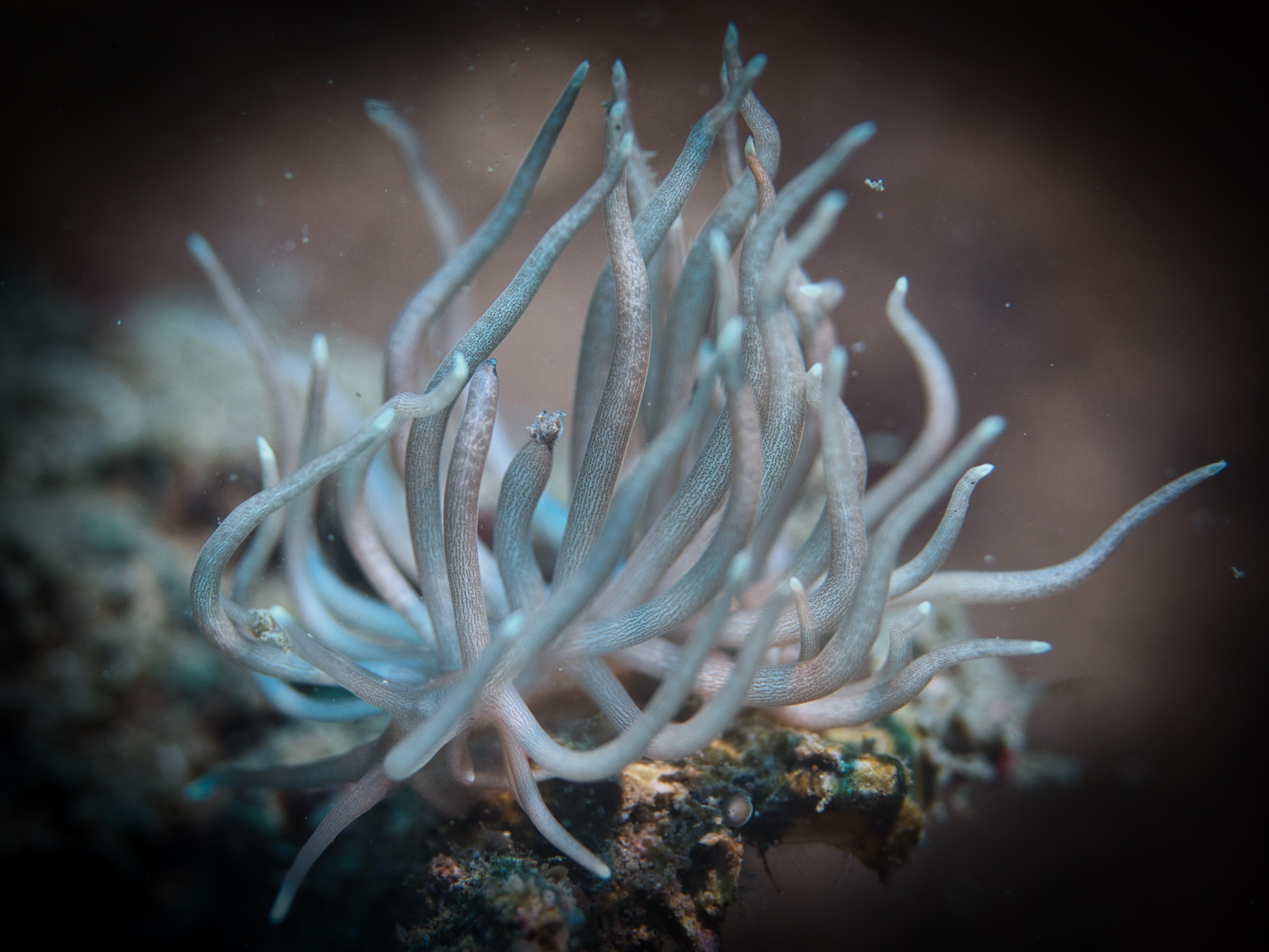
Phyllodesmium briareum — the Yellow-tipped Phyllodesmium — is a solar-powered aeolid nudibranch that mimics the soft coral it feeds on so precisely that most divers never see it. This individual was filmed moving through the reef in Puerto Galera, Philippines, at the northern edge of the Verde Island Passage.
Mimicry in Motion: The elongated cerata covering this animal are not coral polyps — they belong to a nudibranch. Phyllodesmium briareum mimics the briareid soft corals it feeds on so closely that the only reliable way to spot one is to notice that part of the coral is moving.
Puerto Galera sits at the northern edge of the Verde Island Passage — one of the most biodiverse marine corridors on the planet — and the reefs here are rich in the soft corals that Phyllodesmium species depend on. Finding one is less a matter of looking for a nudibranch and more a matter of staring at a patch of soft coral long enough to notice that part of it is moving.
The genus name Phyllodesmium translates roughly to “leaf-like body,” and the species name briareum references Briareos — one of the hundred-handed giants of Greek mythology. It is an apt name for an animal covered in waving, arm-like cerata that match the size, shape, and posture of coral polyps so precisely that the animal disappears into its food source. The species was first described by Bergh in 1896 from specimens collected in Ambon, Indonesia, and has since been documented across the tropical western Pacific.
Solar-Powered Sea Slug: Unlike most nudibranchs, P. briareum harbors zooxanthellae — symbiotic algae harvested from the soft corals it eats. Rather than digesting these single-celled organisms, the nudibranch sequesters them in specialized ducts within its digestive gland, where they continue to photosynthesize and supply the animal with nutrients. It is, in effect, a nudibranch that runs partly on sunlight. According to research documented on the Sea Slug Forum, the zooxanthellae are visible as rows of brown specks through the animal’s translucent body wall — a useful field mark when trying to confirm genus-level identification underwater.
Autotomy Defense: If threatened, Phyllodesmium species can deliberately shed one or more cerata. The detached appendages continue to writhe on the substrate, drawing a predator’s attention while the animal crawls away. The cerata regenerate over time. This defense mechanism, combined with the animal’s near-perfect visual mimicry, makes P. briareum one of the more resilient small invertebrates on the reef — well-defended for something barely an inch long.
Filming Camouflaged Subjects: Close-focus macro work on a subject this well-camouflaged requires a deliberate search pattern and a slow approach. This was shot on the Panasonic GH5 with a 60mm macro lens in a Nauticam housing. The challenge is not the filming itself but the finding — and once found, holding position long enough to let the animal reveal its movement against the coral backdrop. The same patience applies to other cryptic marine life encounters — like filming a Ceratosoma trilobatum laying eggs in Lembeh Strait.
No artificial manipulation of the subject. The animal was filmed exactly as encountered on the reef.
Note on Identification: Phyllodesmium species are notoriously difficult to identify to species level in the field. This individual is tentatively identified as P. briareum based on cerata morphology and the soft coral substrate it was associated with. Over 20 species exist in the genus, and several overlap in range and appearance across the Philippines.


Share Your Thoughts Below