Liveaboard & Accommodation
When a friend called with a last-minute deal on the Galapagos Master, I booked immediately and started arranging travel. Getting to Ecuador from New York is straightforward — we flew from New York to Miami, switched planes, and continued to Guayaquil. When I booked, there were no same-day connections from the mainland to the islands, so plan on at least one night in Guayaquil or Quito before your domestic flight to San Cristóbal. Guayaquil turned out to be easy to get around on foot and by taxi, with good affordable food and a few landmarks worth exploring. We stayed at the Unipark by Oro Verde, which sits directly across the street from Seminario Park, also known as Iguana Park — home to several families of land iguanas that are surprisingly entertaining to watch.
From Guayaquil, it’s a short flight to San Cristóbal Island to meet the liveaboard. There are additional fees required before and upon arrival — including a transit control card purchased online in advance and a national park entrance fee payable in cash at the airport in Galápagos. Once on San Cristóbal, sea lions were everywhere — on stairs, benches, walkways, and bar stools outside the hotel. The locals treat all wildlife with visible respect and expect visitors to do the same.
The Galapagos Master is a 32-meter steel-hulled motor vessel carrying a maximum of 16 divers. Eight cabins are spread across three decks. The lower deck houses four cabins — two fixed twins and two convertible twin/double configurations — none of which have windows or portholes. A single premium double sits on the main deck, and four premium twin/double cabins occupy the upper deck with noticeably more natural light. All cabins are en suite with air conditioning and adequate storage.
The indoor lounge and dining area on the middle deck are comfortable for relaxing between dives or reviewing footage on the flatscreen. Cinematographers and photographers will appreciate the dedicated indoor camera station with multiple US-style round-pin charging points. A sun deck on top and a shaded upper-level lounge offer options for downtime between dives. Wi-Fi is available for a surcharge but is best suited for messaging rather than heavy uploads.
I sailed the 10-night itinerary, which is no longer offered due to changes in Galápagos National Park operator permits. The Galapagos Master now operates exclusively on 7-night itineraries covering the same core dive sites. A crew of 12 runs the vessel, and the atmosphere onboard was friendly and attentive throughout the trip.
How I Got Here
✈️ MIA → GYE
🏨 Layover in Guayaquil
✈️ GYE → SCY
Share This Review
Dive Operation & Facilities
All diving on the Galapagos Master is conducted from two high-powered inflatable pangas rather than directly from the vessel. The crew manages gear transfers to and from the pangas efficiently.
National park regulations require all divers to stay with their assigned guide at all times. The operation requires Advanced Open Water certification, a minimum of 50 logged dives, and documented experience in currents. Night dives are not offered on the Galapagos Master — the itinerary sites involve strong currents and conditions that require all diving to be completed in daylight. On my trip, three guides led dives — two dive guides and a naturalist guide — splitting 16 divers into smaller groups across the pangas.
Nitrox is available through the onboard membrane system for a surcharge. Standard cylinders are 12-liter, with 15-liter tanks available at additional cost. Full equipment rental is offered but is not stored onboard — it’s brought from shore before departure, so pre-booking is strongly recommended to ensure sizes are available. Most divers on a trip like this will be traveling with their own gear. SMBs and Nautilus Lifeline GPS units are provided free of charge, though divers need to bring their own 20- to 30-meter reel or spool for DSMB deployment.
I dove in a 7mm wetsuit with a 5mm hooded vest and was comfortable throughout the trip. That said, if I dive the Galápagos again, I’d try a drysuit — water temperatures can drop to 15°C (59°F) or lower, and the thermoclines at depth can be abrupt.
For cinematographers and photographers, the indoor salon features a dedicated camera station with multiple US-style round-pin charging points and storage drawers toward the aft. The setup comfortably accommodates mid-to-large rig assemblies with enough space to secure housings, service O-rings, and swap batteries out of the weather.
On my trip, the first stop after checkout dives at Isla Lobos and Mosquera was the long crossing north to Darwin and Wolf. We spent roughly a day and a half at each — eight dives at Darwin’s Arch and multiple dives at Wolf across Shark Bay, El Derrumbe, and Pinnacle. From there the itinerary moved south through Punta Vicente Roca, Douglas Cape, Cabo Marshall, and Cousin’s Rock. The 7-night itinerary covers the same signature sites on a tighter schedule.
Would I visit again
Yes
Diving & Marine Life
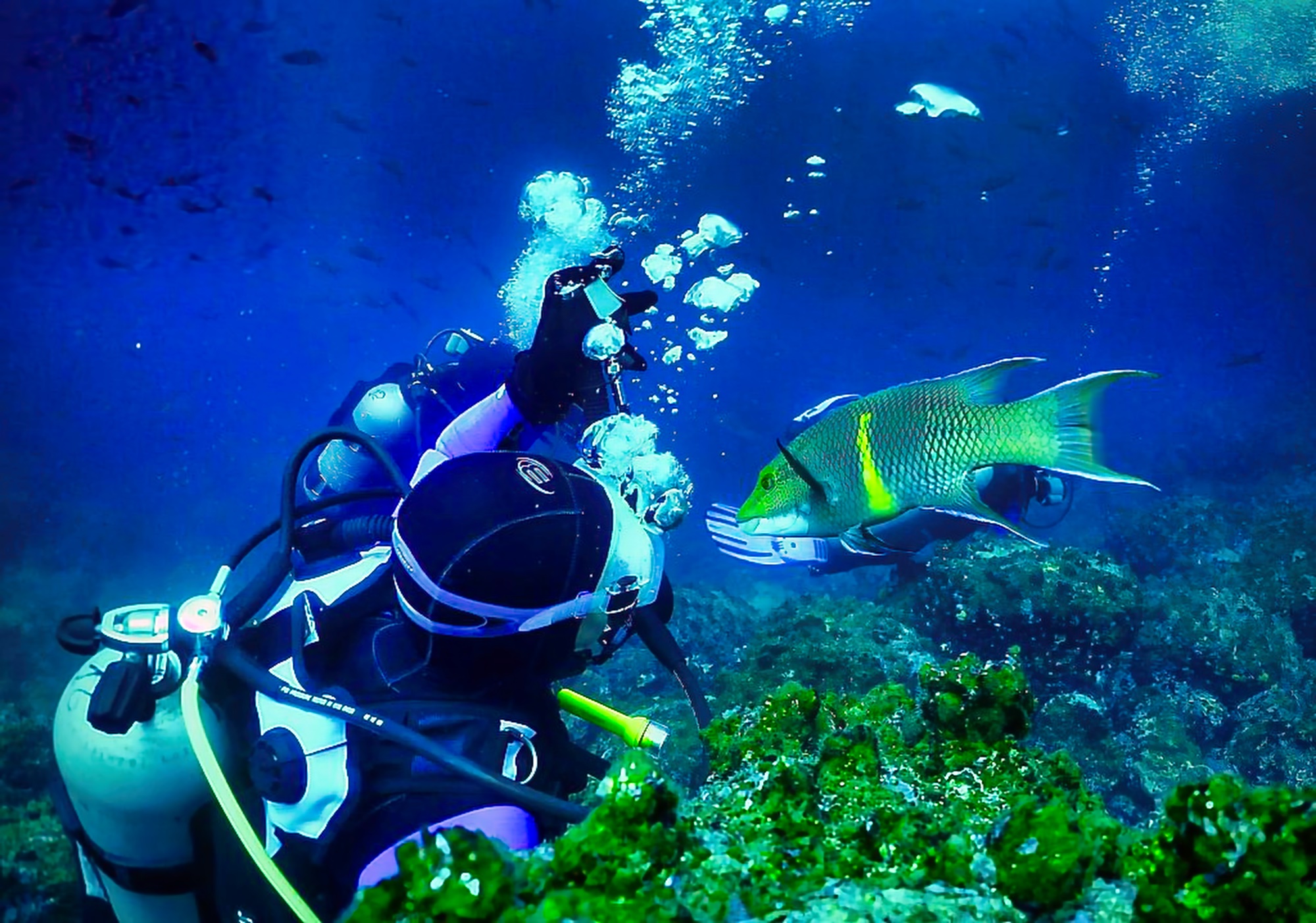
The remote volcanic islands of Wolf and Darwin are the centerpiece of the Galápagos Master itinerary, defined by heavy surge, strong upwellings, and powerful currents. These dynamic conditions are exactly what attract the region’s extraordinary pelagic biomass. Diving here is firmly wide-angle territory, with the focus on large-scale marine life encounters rather than reef detail. Visibility during our trip was not ideal, so some of the footage doesn’t fully convey the scale — but the experience itself absolutely delivered.
At Darwin’s Arch, large schools of scalloped hammerheads were present on nearly every dive, often accompanied by Galápagos sharks and silky sharks. One standout moment included a close encounter with a tiger shark, adding a surge of intensity to an already stacked pelagic lineup. Across the trip, sightings also included whale sharks, mola mola, and sea lions, reinforcing the Galápagos as one of the most biologically rich shark-diving destinations in the world.
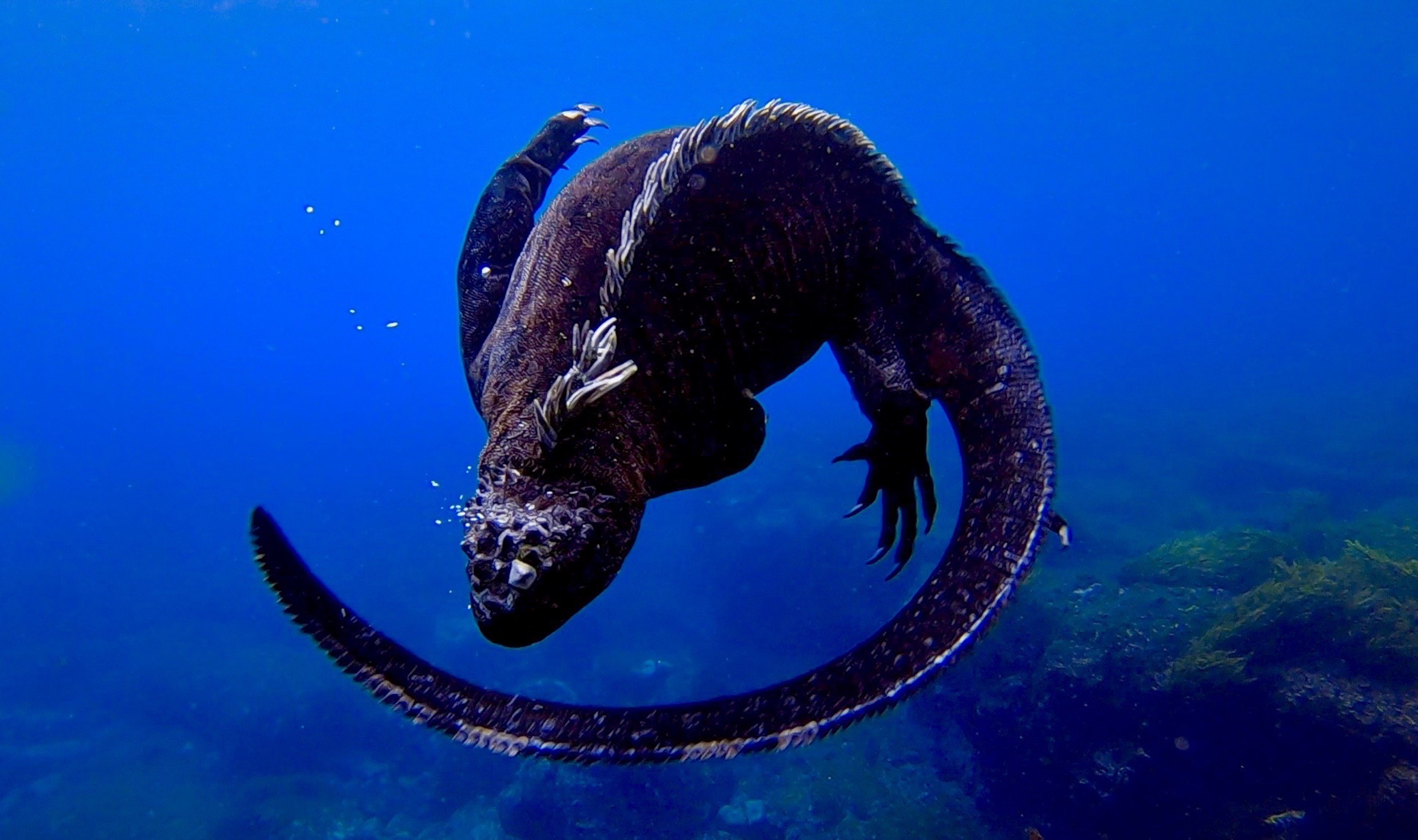
Beyond the blue-water action, the itinerary expands into unique environments at Punta Vicente Roca, Cabo Douglas, Cabo Marshall, and Cousin’s Rock. Cabo Douglas offered one of the most distinctive encounters of the trip: diving with marine iguanas, the only lizards on Earth that forage underwater. Watching them grip volcanic rock in surge while grazing on algae is a striking example of the Galápagos’ evolutionary uniqueness. This site also produced sightings of the elusive Galápagos bullhead shark, a rarely observed, bottom-dwelling species with a limited range and still largely undocumented life cycle.
Additional highlights across these sites included spotted eagle rays cruising along reef edges, penguins darting through the water, and macro life such as nudibranchs adding contrast to the otherwise pelagic-heavy experience. Cabo Marshall and Cousin’s Rock rounded out the trip with vibrant reef scenes and schooling fish, offering a change of pace from the high-energy drift dives.
Between the density of sharks, the rare endemic species, and the constant sense of unpredictability, the Galápagos fully lives up to its reputation — and it’s a destination I would return to without hesitation.
MONTH VISITED
Dive Reviews
A growing collection of firsthand reviews covering dive shops, resorts, and liveaboards worldwide.
Browse All Reviews →Quick Facts
- Diving: Tender-based
- Multiple Panga/Skiff: Yes
- Nitrox: Yes
- Night Diving: No
- Camera Table: Yes
- Sundeck: Yes
- Wi-Fi: Yes
Featured Images